We’ve all been there: staring at a blinking cursor on a blank page, the deadline breathing down your neck. It’s the classic student nightmare. But what if I told you the secret to writing faster isn't about working harder? It’s about working smarter.
The real key to how to write essays faster is adopting a strategic process that breaks the whole ordeal down into smaller, much more manageable stages. Think of it less like a marathon and more like a series of focused sprints.
Your Blueprint for Rapid Essay Writing
Forget that old-school, linear approach where you try to write from the first word to the last in one go. That’s a recipe for burnout. A much faster—and frankly, better—method is to tackle your essay in distinct phases. This strategy can slash your writing time while actually boosting the quality of your final draft.
The whole idea is to front-load the heavy lifting—the thinking, planning, and organizing—so that when you finally sit down to write, it's more like filling in the blanks of a plan you've already perfected.
This guide is your direct, actionable blueprint. We'll walk through deconstructing the prompt, nailing down a thesis, flying through research, and building a rock-solid outline. It’s a clear, step-by-step game plan for writing better essays in a fraction of the time.
This four-stage process is designed for efficiency, moving you from initial prep to final polish without the usual stress.
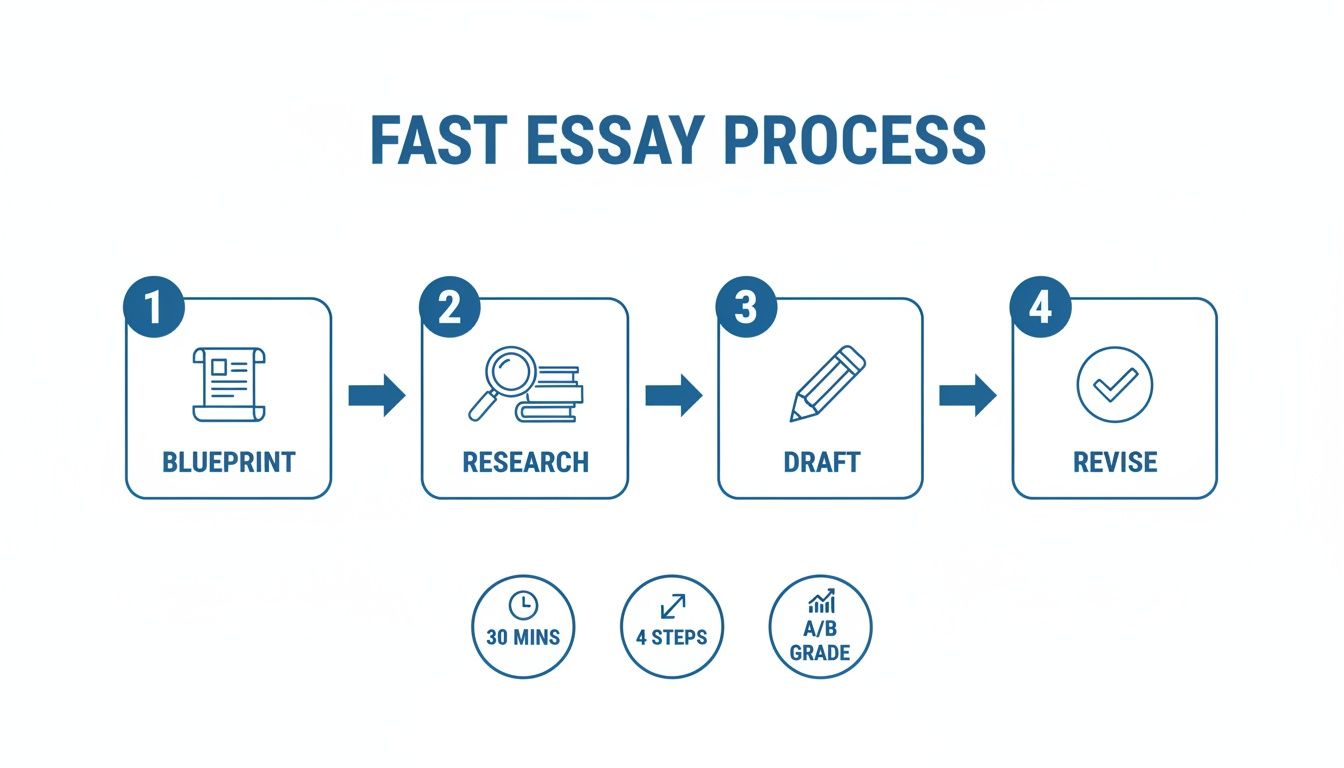
As you can see, the actual drafting is just one piece of the puzzle. It's part of a bigger, more structured system built for both speed and quality.
Embrace Modern Tools and Techniques
The academic world is changing, and your toolkit should, too. Smartly integrating technology, especially AI, is no longer a fringe practice; it's how top students work efficiently. In fact, a recent study at an elite U.S. college found that 80% of students use generative AI to help with their academic work.
Their main goals? Improving readability (51% of the time) and checking grammar (22%). This shows that students aren't using AI to cheat the system but as a powerful assistant for polishing their work. You can dig into more of these emerging academic writing trends on sqmagazine.co.uk.
To give you a clearer picture of how these phases work together, here's a quick summary of the workflow we'll be breaking down.
The Four Stages of Faster Essay Writing
| Stage | Key Action | Primary Goal |
|---|---|---|
| Blueprint | Deconstruct the prompt and build a solid outline. | Create a clear roadmap to guide your writing. |
| Research | Gather targeted evidence and sources quickly. | Find the best supporting material without wasting time. |
| Draft | Write the first version without stopping to edit. | Get your ideas down on the page as fast as possible. |
| Revise | Edit for clarity, structure, and grammar. | Polish your draft into a final, high-quality essay. |
This structured approach, combining solid planning with smart tools, is the core of modern academic success.
A well-planned essay doesn’t just help you write faster—it helps your instructor read and mark it faster. Your structure creates clarity, making it easier to follow your argument from start to finish.
Many of these principles aren't just for essays; they're universal strategies for producing great work under pressure. You can dive deeper into these concepts in our guide to content creation best practices.
Mastering Research and Outlining in Record Time
Let's be honest, the two biggest time-sucks when writing an essay are aimless research and a flimsy plan. We've all been there—falling down a rabbit hole of irrelevant articles or, even worse, starting to write with only a vague idea of where you're going. It's a surefire recipe for a slow, painful process.
If you want to learn how to write essays faster, the secret is conquering these first two stages.
Instead of casting a wide, random net in Google Scholar, you need to get hyper-specific from the get-go. Use targeted keyword strings and the filters in academic databases to find high-quality sources in a fraction of the time. Don't just search for "climate change effects." Try something like "long-term effects of rising sea levels" AND "coastal erosion" AND "North Atlantic". That level of precision cuts right through the noise.
Adopt the Pyramid Research Method
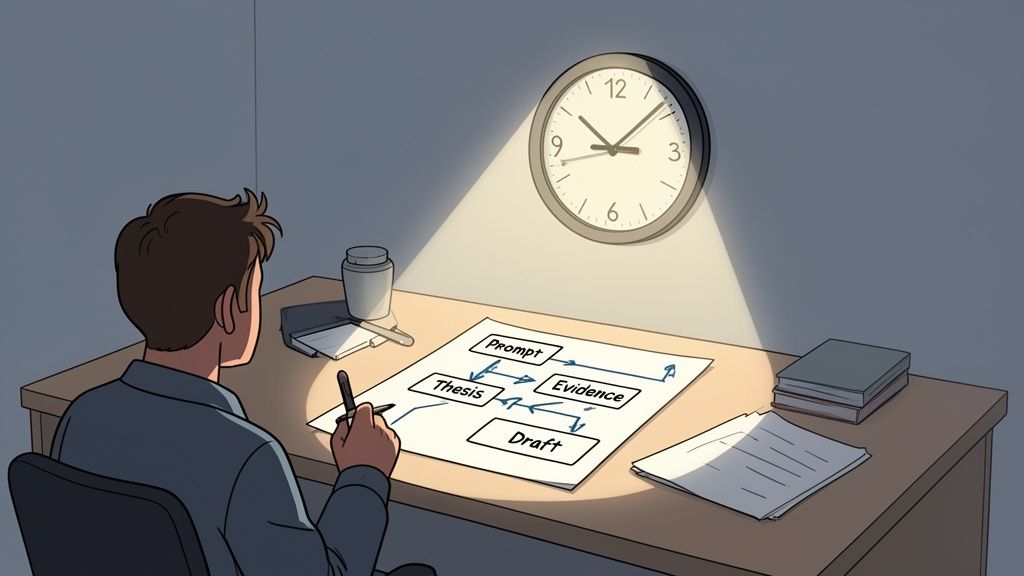
One of the most powerful strategies I've found is the ‘pyramid research’ method. It works by starting broad before quickly narrowing your focus to the most relevant, high-impact material. This structured approach stops you from wasting hours on sources that won't even make it into your final paper.
Here’s how it looks in practice:
- Top Level (Broad Overview): Kick things off with one or two foundational texts—think a textbook chapter or a well-regarded review article. Your only goal here is to get a solid grasp of the main concepts and identify the key experts or seminal studies.
- Middle Level (Targeted Investigation): Now, use the bibliographies from those initial sources. You're basically following the trail of citations to discover the most influential works in the field. This is how you find the good stuff.
- Bottom Level (Specific Evidence): Finally, you're hunting for direct quotes, statistics, and specific data points from the highly relevant sources you've unearthed. This is where you grab the concrete evidence to back up your arguments.
This method turns research from a meandering exploration into a surgical strike. It saves you an incredible amount of time and ensures every source you pull has a direct purpose.
Create a Dynamic Skeleton Outline
Once your research is dialed in, the next step is building a ‘skeleton outline.’ This isn't just a simple list of topics; it's a structural roadmap that maps out your entire argument before you write a single complete paragraph. A great outline makes the actual writing feel like you're just filling in the blanks.
Your skeleton outline should include:
- Your thesis statement sitting right at the top.
- Topic sentences for each of your body paragraphs.
- Bulleted evidence (quotes, data, examples) tucked under each topic sentence.
- Brief notes on how each piece of evidence supports its topic sentence.
An essay is just a collection of paragraphs, and a paragraph is just a collection of sentences supporting one main idea. When you build the skeleton first, you ensure every piece has a logical place, which eliminates writer’s block.
Think of it this way: your brain can’t focus on high-level argument structure and sentence-level grammar at the same time. Separating those tasks is absolutely crucial. By building a detailed outline, you solve all the big-picture problems upfront.
When it's time to actually draft, your cognitive load is way lower, letting you focus purely on prose and flow. This separation is the engine that drives fast, high-quality writing.
Drafting with the 'Zero-Draft' and Focused Sprints
With a solid outline in hand, the single biggest thing that will slow you down now is perfectionism. We’ve all been there—agonizing over every single word, rewriting sentences before we’ve even finished a paragraph. It feels productive, but it’s actually a massive time-sink. To really speed up your essay writing, you need a new drafting philosophy that’s all about momentum.
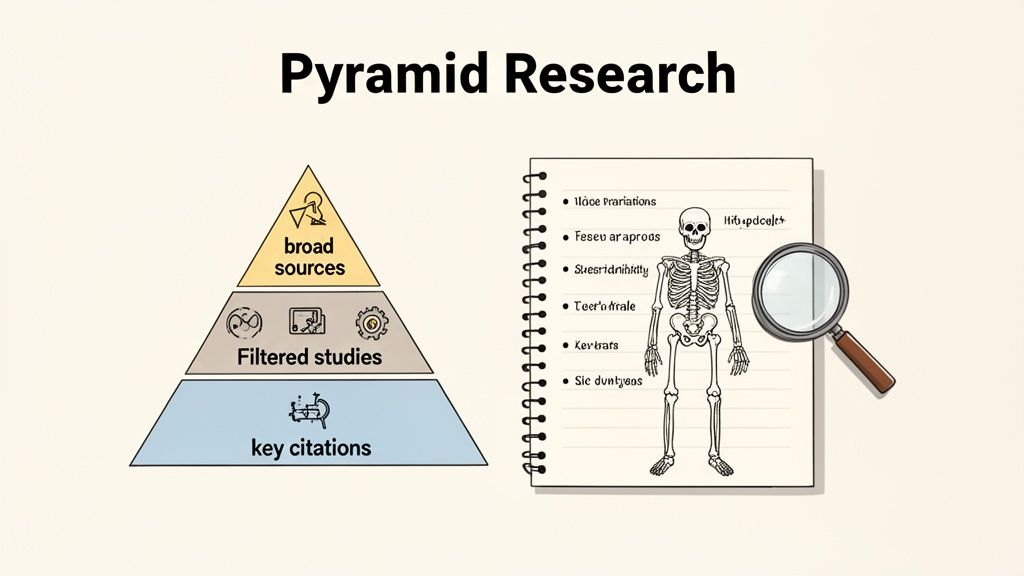
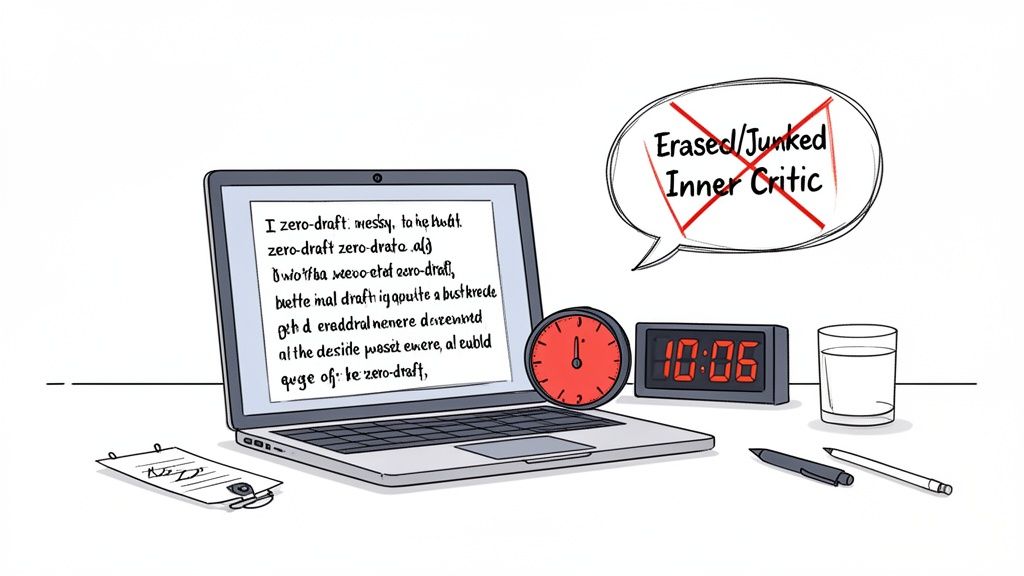
This is where the 'Zero-Draft' comes in. The only rule? Get your ideas out of your head and onto the page. No friction, no second-guessing. You have to actively silence your inner editor and just write.
Don't stop to hunt for the perfect synonym. Don't worry if your phrasing feels a little clunky or you’ve used the word "however" three times in a row. Just let the words flow. Your outline has already done the heavy lifting of organizing your arguments; your only job now is to flesh them out.
Embrace Focused Sprints
Trying to write for hours straight is a surefire way to burn out. Your brain simply isn't designed for that kind of sustained, high-level focus. The trick is to stop thinking of drafting as a marathon and start treating it like a series of short, manageable sprints.
The Pomodoro Technique is a game-changer for this. It’s incredibly simple but shockingly effective:
- Set a timer for 25 minutes. This is one focused sprint.
- Work on nothing but your essay. Close other tabs, put your phone on silent. Zero distractions.
- When the timer rings, take a 5-minute break. Get up, stretch, grab a glass of water. Do anything but work.
- After four sprints, take a longer break of 15-30 minutes.
This method keeps your energy high and prevents that overwhelming feeling of staring at a blank page with an entire essay to go. You’re only ever thinking about the next 25 minutes.
The Power of Task Batching
Another killer strategy is task batching. This just means grouping similar activities together and carving out dedicated time for them. So instead of bouncing between researching, writing, and editing, you do them in separate, focused blocks.
For example, you might block out two hours just for drafting the body paragraphs. During that time, you’re not allowed to look up a new source or fix a typo. That comes later.
This separation is so important because context-switching absolutely murders productivity. Every time you shift gears from writing to editing, your brain has to reorient itself, which costs you precious time and mental energy.
By batching your writing into focused sprints, you create a powerful, distraction-free bubble where your only job is to write. You can relax and trust that you have separate time scheduled later to polish everything. This approach not only helps you crank out essays faster, but it also leads to a more cohesive first draft because your focus never wavers.
Building an AI-Powered Writing Workflow
Juggling a dozen different AI models in separate browser tabs is a recipe for disaster. It shatters your focus and kills the very time you're trying to save. A far better approach is to build a single, integrated workflow where AI becomes a true co-pilot, helping you at every stage—from research all the way to the final polish.
This is where a unified AI command center like Pulsaro really changes the game. Instead of bouncing between ChatGPT for brainstorming, Claude for summarizing, and Perplexity for research, you can pull them all into one consistent interface. For anyone serious about figuring out how to write essays faster, this kind of integrated setup is non-negotiable.
This screenshot gives you a glimpse of what that looks like. You can see multiple AI models side-by-side, letting you compare outputs without ever leaving your main workspace.
The real magic here is efficiency. You can fire off one prompt to multiple AI engines at once to gather different perspectives, check for consistency, and cherry-pick the best response for whatever you’re working on.
Prompts for Lightning-Fast Research
Your research phase can get a massive speed boost with the right prompts. Forget just asking for general information; you can get AI to handle high-level academic tasks that would normally eat up hours of your time. This is where AI stops being a fancy search engine and becomes a powerful research assistant.
Try getting specific with your prompts:
- Generate a Literature Review: "Act as a research assistant. Generate a concise literature review on [Your Topic], focusing on the key debates between [Author A's Theory] and [Author B's Theory]. Pinpoint the primary themes and any gaps in the current research."
- Summarize Complex Papers: "Summarize the key findings, methodology, and conclusions of the attached academic paper: [Paste Text or Link]. Pull out the three most important stats and list them as bullet points."
The point isn’t to have AI write your essay for you. It’s about delegating the grunt work—letting it process and synthesize mountains of information so you can stay focused on the actual thinking and analysis.
This approach is already making waves in academia. A Cornell University study found that scientists using large language models published roughly one-third more papers than their colleagues. The productivity jump was even bigger in other fields, proving that AI augmentation is quickly becoming the new standard.
AI-Assisted Outlining and Drafting
Once your research is solid, AI can help you structure your argument and blast through writer's block. It's especially good at helping you see your argument from different angles and polishing your sentences for clarity.
For Structuring Arguments
Go way beyond a simple list of topics. Use prompts to build a stronger, more critical outline that actually anticipates counter-arguments.
- Prompt Example: "Create a detailed outline for an essay arguing that [Your Thesis Statement]. Include three main supporting points. For each point, provide a counter-argument and a solid rebuttal to that counter-argument."
For Drafting and Refining
This is where you turn that bulleted outline into smooth, flowing paragraphs without all the usual pain. Think of AI as your tireless writing partner, ready to help you expand, rephrase, and polish your ideas on demand. You can dive deeper into these techniques in our guide on automatic content creation.
Here are a few prompts to get your draft done faster:
- Expand Bullet Points: "Expand these bullet points into a cohesive, logical paragraph: [Paste Your Bullet Points from Outline]."
- Improve Clarity and Style: "Rewrite this sentence to be more concise and academic in tone: [Paste Your Sentence]."
- Suggest Alternatives: "Give me three alternative ways to phrase this concluding sentence to make it more impactful: [Paste Your Conclusion]."
By building an AI-powered workflow like this, you’re not just writing—you’re creating a streamlined system. You’ll save hours of time and seriously elevate the quality of your final essay.
Editing Your Essay with Speed and Precision
Your first draft is officially on the page. Now what? The real magic happens in the editing phase, but it's also where countless hours get wasted.
The goal here isn't to catch every tiny error in one go. That’s a classic rookie mistake. A much smarter way to edit is with a layered approach, ensuring you don't spend an hour perfecting a sentence that might get cut later.
Start with the Big Picture: The Macro-Edit
Before you even think about commas or typos, take a step back and look at the structure. This is your macro-edit, and it's all about argument, structure, and flow.
A killer technique for this is the 'reverse outline.' Just read through your essay and jot down the main point of each paragraph in the margin. When you look at your notes, does the order make sense? Does each point build on the last? This simple exercise is brutally effective at exposing a weak structure.
Another trick I swear by is reading the whole thing aloud. Your ears are incredible at catching things your eyes miss, like clunky phrasing, repetitive sentence starters, or sections where the flow just feels off. It feels a bit silly at first, but it's one of the fastest ways to make your writing sound more natural.
Zoom In on the Details: The Micro-Edit
Once you're confident the structure is solid, it's time to pull out the magnifying glass. This is the micro-edit—where you hunt down grammar issues, refine your word choices, and squash typos. Tackling this after the macro-edit means you’re only polishing paragraphs that have truly earned their spot in the essay.
This is where AI tools can seriously accelerate your workflow, doing way more than a simple grammar check. Professionals are already seeing massive returns here. More than half report that AI saves them at least half a day each week, and some founders are clawing back over 6 hours weekly while actually improving the quality of their work. You can dig into the specifics of these AI productivity gains at Lenny's Newsletter.
The key is to use AI with surgical precision. Don't just ask it to "edit this." Give it specific, analytical commands.
Treat AI as a strategic partner, not just a proofreader. By giving it targeted tasks, you can get high-level feedback that sharpens your argument and clarifies your message in a fraction of the time.
Here are a few prompts you can adapt to turn a generic AI into your personal writing coach:
- For Logical Flow: "Act as a critical thinking tutor. Read this paragraph and identify any logical fallacies or weak points in the argument. Suggest two ways I can strengthen the reasoning."
- For a Powerful Conclusion: "Suggest three alternative ways to phrase this concluding sentence to make it more impactful and memorable: [Paste your sentence here]."
- For Crystal-Clear Writing: "Pinpoint any sentences in this section that might be confusing for a reader. Offer a clearer, more concise version for each one."
This one-two punch of a human-led macro-edit followed by an AI-assisted micro-edit will get your essay polished and ready to go in record time.
Have Questions About Writing Essays Faster? Let's Clear Them Up.
Even when you're armed with the best strategies, trying to speed up your writing can bring up a few nagging questions. It's smart to tackle these head-on. That way, you’re not just writing faster—you’re writing smarter and keeping your academic integrity intact.
Let’s get a few common uncertainties out of the way.
A huge one right now is about AI. Is using it to write essays faster considered cheating? The answer really boils down to how you use it.
Think of AI as an incredibly powerful assistant, not a ghostwriter. Using it to brainstorm ideas, spitball an initial outline, summarize a dense research paper, or polish your grammar is generally fine. In fact, it's a smart move. You cross the line when you submit text generated entirely by AI and pass it off as your own. That’s plagiarism, plain and simple. The trick is to use these tools to enhance your own thinking, not to replace it.
What's the Single Best Habit for Faster Writing?
If I had to pick just one habit, it would be this: create a detailed skeleton outline before you even think about writing the first sentence. This is, without a doubt, the most effective way to speed up the entire process because it forces you to do the hardest part—organizing your thoughts—right at the start.
A solid outline is your roadmap. It breaks the massive task of "writing an essay" into small, logical chunks. Instead of staring down a terrifyingly blank page, your job becomes much simpler: just flesh out each point you've already planned. This approach pretty much kills writer's block on arrival and guarantees a coherent flow from your introduction to your conclusion. For more tips on building effective content structures, you can find other guides on the Pulsaro blog.
The most time-consuming part of writing isn’t the typing; it’s the thinking. When you solve the structural problems in the outline phase, the drafting phase becomes exponentially faster.
How Can I Actually Avoid Distractions?
When you're on a tight deadline, distractions are public enemy number one. You need a proactive strategy, not just willpower. The Pomodoro Technique is a fantastic starting point: work in hyper-focused 25-minute sprints, then take a short break. It works.
Next, you have to curate your environment. This isn't optional. Use website blockers to kill your access to social media and news sites. Physically move your phone into another room. Out of sight, out of mind.
Finally, set a ridiculously small, clear goal for each writing session. Don't aim to "write the essay." Aim to "write the introduction" or even just "write the first paragraph." This makes the task feel way less intimidating, which helps you stay on track and build momentum.
Ready to unify your AI tools and slash your writing time? Pulsaro brings the world's leading AI models—from GPT and Claude to Gemini and Perplexity—into a single, streamlined Mac app. Stop juggling tabs and start building a truly efficient workflow. Download your free trial of Pulsaro today.