Automatic content creation is all about using AI to generate text, images, and other media with as little hand-holding as possible. Think of it as upgrading from a manual assembly line to a fully automated factory. Instead of painstakingly building every piece of content by hand, you’re overseeing a powerful system that produces it at scale.
What Is Automatic Content Creation and Why It Matters

At its heart, automatic content creation means using artificial intelligence to dramatically speed up how you produce digital materials. This isn't just about cranking out blog posts faster; it’s a fundamental shift in the entire content lifecycle, from brainstorming ideas all the way to publishing the final assets.
This shift is happening right now because powerful generative AI models are more accessible and capable than ever before. For businesses, this means the relentless pressure to produce fresh, engaging material can finally be met with a real, practical solution. The market is definitely responding.
The global AI-Powered Content Creation Market was valued at USD 2.98 billion in 2024 and is expected to rocket to USD 8.31 billion by 2030, growing at a compound annual growth rate (CAGR) of 18.65%. This explosive growth shows just how much creators and marketers are leaning on AI to automate production, slash costs, and scale personalized campaigns. You can dive deeper into the numbers by reading the full market research.
The Goal Is Amplification, Not Replacement
A common myth is that automation is here to replace human creativity. Nothing could be further from the truth. The real goal is to amplify it.
By offloading the repetitive, time-sucking tasks to an AI, creators can finally focus on what they do best: strategy, nuanced editing, and adding the unique human insights that actually connect with an audience.
The most effective approach is a hybrid model where automation handles the heavy lifting of drafting and ideation, while humans provide the critical final touch of refinement, fact-checking, and creative direction.
This guide will walk you through how to apply this powerful technology, no matter your role. You'll get to know the key techniques and workflows that let you produce higher-quality work, much faster. Let's also explore the tangible benefits you can expect from a well-oiled system.
Key Benefits of Automating Content
Putting an automated workflow in place delivers real advantages that go way beyond just saving time. The core benefits help businesses become more agile, consistent, and effective in how they communicate.
Here's a quick look at the major wins you can expect when you bring AI into your content process.
Key Benefits of AI-Driven Content Automation
| Benefit | Description | Example Impact |
|---|---|---|
| Increased Productivity and Speed | Generate first drafts, social media updates, and ad copy in minutes, not hours. | A marketing team can launch three campaigns in the time it used to take for one. |
| Enhanced Brand Consistency | Use predefined templates and style guides to ensure every piece of content has a uniform voice and tone. | A global company maintains a consistent brand message across all regional markets. |
| Improved Scalability | Effortlessly scale content for different platforms and audiences without a proportional increase in headcount. | A small e-commerce store creates unique product descriptions for thousands of items. |
| Greater Personalization | Analyze user data to create tailored content that speaks directly to individual needs and preferences. | An email campaign achieves a 25% higher click-through rate with personalized subject lines. |
As you can see, the impact isn't trivial. These advantages compound over time, giving you a serious competitive edge.
By centralizing these capabilities in a unified platform like Pulsaro, professionals can make automatic content creation a practical and powerful part of their daily operations.
The Building Blocks of AI-Powered Content
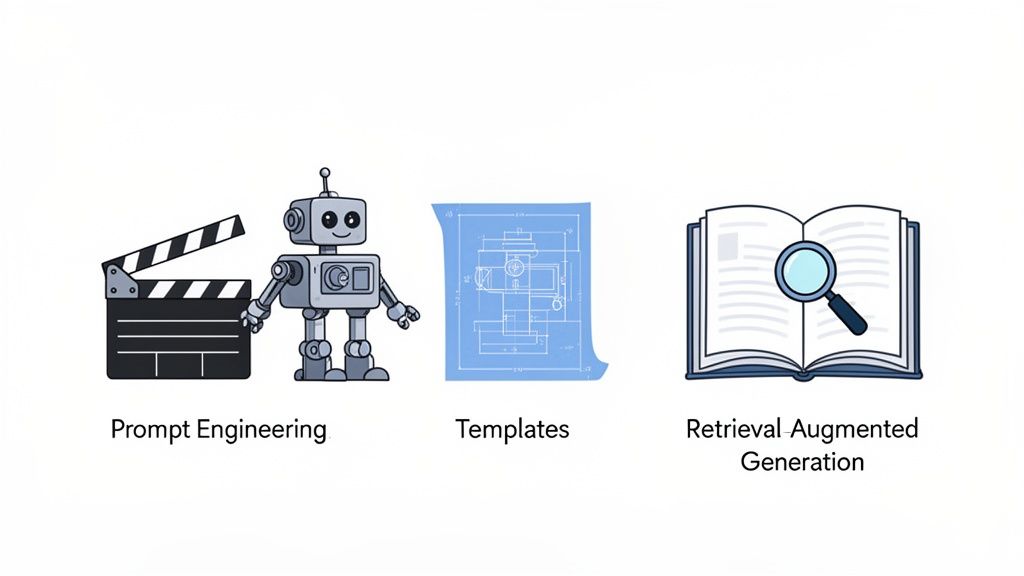
To really get the hang of automatic content creation, you don't need a PhD in data science. You just need to know the core techniques that make it all work. Think of them as different tools in your workshop—each one is built for a specific job, and the real skill lies in knowing which one to grab.
Instead of drowning in technical jargon, let's break these down with some simple analogies. Once you grasp these concepts, you'll be able to guide AI models with more confidence, leading to sharper, more relevant content.
Prompt Engineering: The AI Director
At its heart, talking to an AI is all about giving it a command, or a prompt. But prompt engineering is where the real magic happens. It’s the art of crafting your instructions so precisely that you get the exact output you envisioned. This is less like typing a search into Google and more like a film director coaching an actor to nail a scene.
Tossing out a vague request like "write about marketing" will get you a bland, forgettable article. But a detailed prompt that outlines the audience, tone, key points, and desired length will produce something far more compelling.
For instance, a solid prompt might look something like this:
- Role: You are an expert SEO strategist writing for a B2B audience of small business owners.
- Task: Write a 500-word introduction for a blog post on the benefits of email marketing automation.
- Tone: Professional, informative, and encouraging.
- Include: Specific benefits like time savings, personalization at scale, and better lead nurturing.
This level of detail turns a simple command into a crystal-clear creative brief, leaving no room for the AI to guess what you want.
Templates and Structured Inputs: The Content Blueprint
While prompt engineering is fantastic for one-off, custom pieces, templates and structured inputs are your go-to for creating consistent content at scale. It's like using a detailed blueprint to build a house—it ensures every room is the right size and in the right place, every single time.
In the world of automatic content creation, a template could be a pre-built structure for a product description, a weekly social media post, or a customer service reply. You just plug in the variable data—like a product name, key features, or a customer's question—and the AI fills in the blanks according to the established format.
This method is a lifesaver for tasks where brand voice and structure are non-negotiable. It guarantees every piece of content, no matter who generates it, sticks to your company’s guidelines.
Templates effectively turn content creation into a production system. It’s not just fast; it's remarkably consistent. You remove the guesswork and ensure every output hits a predefined standard for quality and style.
This systematic approach is especially powerful in the Digital Content Creation market, which is on track to hit USD 36.84 billion in 2025. Within this booming sector, textual content commands the largest market share thanks to its SEO value, and about 45% of AI content tools are geared toward text generation to meet this demand. Automation is a game-changer for marketers who need to create optimized blogs and articles faster. You can explore detailed market insights on cognitivemarketresearch.com to learn more.
Retrieval-Augmented Generation: The Open-Book Test
One of the big limitations of standard AI models is that their knowledge is frozen in time, based on when they were trained. Retrieval-Augmented Generation (RAG) brilliantly solves this by giving the AI a library card to access external, up-to-the-minute information.
Imagine asking an AI to write a report on your company's latest quarterly sales figures. A standard model would have no clue. But with RAG, you can feed it your internal sales documents. The model then "retrieves" the key facts from those documents to "augment" its response, generating a report that's both accurate and contextually aware.
It’s like giving the AI an open-book test. Instead of just relying on memory, it can reference specific, trusted sources to find the right answers. This technique is a game-changer for creating content that relies on proprietary data, recent events, or specialized knowledge.
Fine-Tuning: The Specialist Apprentice
If RAG is like giving an AI an open book, fine-tuning is like training it to become a specialist apprentice. This is a more advanced technique where you take a general-purpose AI and train it further on your own specific dataset—things like your company's past blog posts, marketing copy, and customer emails.
Through this process, the model doesn't just learn your instructions; it absorbs your unique brand voice, style, and terminology. It starts to intrinsically "sound" like you. A fine-tuned model can generate new content that's already in line with your established voice, slashing the time you spend editing.
Fine-tuning is an investment, for sure. But for organizations pumping out a high volume of content, it delivers a level of brand consistency and efficiency that’s hard to beat. It’s about creating a bespoke AI assistant that’s perfectly molded to your needs.
Multimodal Generation: The Versatile Artist
Finally, multimodal generation showcases how AI is breaking out of its text-only box. "Multimodal" is just a fancy way of saying the AI can understand and create content in different formats—images, audio, and video—often from the very same prompt.
Think of it like hiring a versatile artist who can not only write the script but also sketch the storyboards, compose the music, and even generate the final animation. Modern tools can now take a single creative brief and spin it into a blog post, a custom hero image for that post, and a short promotional video clip. This integrated approach to automatic content creation is completely changing the game for digital marketing and media.
So, you have all these powerful AI models at your fingertips. Now what? Moving from playing around with AI to actually building a reliable content engine requires a plan. This isn't about hitting "generate" and calling it a day; it's about creating a structured workflow that makes sense.
A good workflow turns a collection of separate tools into a smooth, predictable production line. We've found the most effective systems break the process down into four distinct stages. Each step builds on the last, giving you checkpoints to ensure the final piece is accurate, on-brand, and genuinely useful.
Stage 1: Ideation and Keyword Analysis
Every piece of killer content starts with a solid idea. In this first stage, think of AI as your super-powered brainstorming partner. You can feed it a core theme and get back hundreds of potential blog topics, social media hooks, or video scripts in minutes. It's a great way to cast a wide net and explore angles you might have missed.
But it goes deeper than just spitting out ideas. AI can dig into keyword trends and search intent data to find topics people are actually searching for. You can prompt a model with a few competitor URLs or industry terms and quickly map out content gaps and opportunities. This ensures your efforts are grounded in data from the get-go.
Stage 2: First Draft Generation
With a validated idea in hand, it's time to generate the first draft. This is where you need to be strategic about choosing the right tool for the job. Not all AI models are built the same—some are brilliant creative writers, while others are masters of technical explanations or summarizing dense information.
For instance, you might lean on GPT-4 for its impressive creative drafting, then switch over to Claude to distill complex research into a few clear, digestible points. The trick is matching the model to the task. Constantly switching between different apps and subscriptions is a real pain, which is where a central hub becomes invaluable.
An integrated AI command center saves you from the headache of app-switching. It lets you pick the best model for any given task—drafting, summarizing, or editing—all from one clean interface.
Stage 3: Iterative Refinement and Human Editing
This is where the magic really happens, and frankly, it's the most critical step for quality. No AI draft is publication-ready. This is where the "human-in-the-loop" approach shines, blending machine efficiency with human expertise.
Think of it as a collaboration. The AI does the heavy lifting of getting the initial words down, freeing you up to focus on the high-value tasks only a human can do:
- Adding personal stories or specific case studies that an AI could never invent.
- Fact-checking all stats and claims against reliable sources.
- Injecting your brand's unique personality and point of view.
- Restructuring the narrative for maximum impact and readability.
This back-and-forth between generating, reviewing, and refining is what transforms a decent automated article into something truly exceptional.
Stage 4: Quality Control and Final Polish
The last stop is a final, comprehensive quality check. This is more than just a quick proofread. You're making sure the content ticks all the boxes: it aligns with brand guidelines, is formatted correctly for the platform (blog, social media, etc.), and is optimized with the right keywords and meta descriptions.
This is also your chance to double-check that all links are working and that any images or videos are integrated properly. The goal is a seamless, end-to-end system. A unified AI command center helps tie it all together, letting you manage everything from the first draft to the final check without friction. For example, with a central hub like the Pulsaro dashboard, you can run your entire content pipeline, easily passing context between different models and keeping the whole process in one place. That’s how you build an engine that truly works.
Putting Automatic Content Creation to Work: Real-World Examples
Theory is one thing, but seeing automatic content creation in the wild is where it all clicks. This isn't some far-off concept; it’s a practical tool that professionals are using right now to get more done, improve their output, and scale their work in ways that were previously impossible. From marketing teams to software developers, the applications are as diverse as they are impactful.
Let's walk through a few concrete examples. Each one pinpoints a common headache, shows how an automated workflow provides the solution, and highlights the real, measurable results.
For Marketers and SEO Specialists
Every marketing team knows the grind. The demand for a constant stream of blog posts, social media updates, and ad copy can be relentless, quickly eating up resources and leaving no time for big-picture strategy.
The Problem: A small e-commerce brand was struggling to publish three SEO-focused blog posts a week to compete for valuable keywords. With only one writer, they were constantly behind schedule, and their content output was inconsistent at best.
The Automated Solution: The team built a workflow where an AI model generated detailed outlines and first drafts based on their target keywords. The writer’s job transformed—instead of staring at a blank page, they focused on refining the drafts, fact-checking, and weaving in the brand’s unique voice and stories.
The Results:
- Time Saved: The writer slashed their drafting time by a staggering 70%, freeing up nearly 10 hours a week for strategic planning and promotion.
- More Content: They easily hit their goal of three high-quality posts per week, which boosted their visibility in search results.
- Better Quality: With the heavy lifting of drafting off their plate, the writer could add deeper analysis and compelling customer stories to every article.
This shift from pure creator to strategic editor is a game-changer. It allows marketers to multiply their output without losing the human touch that actually connects with an audience.
For Software Developers
Let's be honest: writing technical documentation is a chore. It’s absolutely essential for helping users and keeping development teams aligned, but it’s also incredibly time-consuming. Developers often find themselves bogged down explaining complex code instead of building the next great feature.
The Problem: A software startup needed to build out comprehensive documentation for a new API. Their development team was already stretched thin and didn't have the bandwidth to write clear, user-friendly guides from scratch.
The Automated Solution: They turned to an AI model equipped with Retrieval-Augmented Generation (RAG). By feeding it their source code and internal notes, the AI generated the first drafts of function descriptions, code examples, and step-by-step tutorials.
The Results:
- Documentation in Days, Not Weeks: A task that would have taken weeks of manual effort was drafted in just a couple of days.
- Crystal-Clear Explanations: The AI was particularly good at translating dense, technical jargon into simple language that even non-technical users could follow.
- Fewer Support Tickets: With clear documentation readily available, the number of user support questions dropped by 20% within the first month.
This workflow visualizes the process perfectly, moving from AI-powered ideation and drafting to the essential stages of human-led refinement and control.
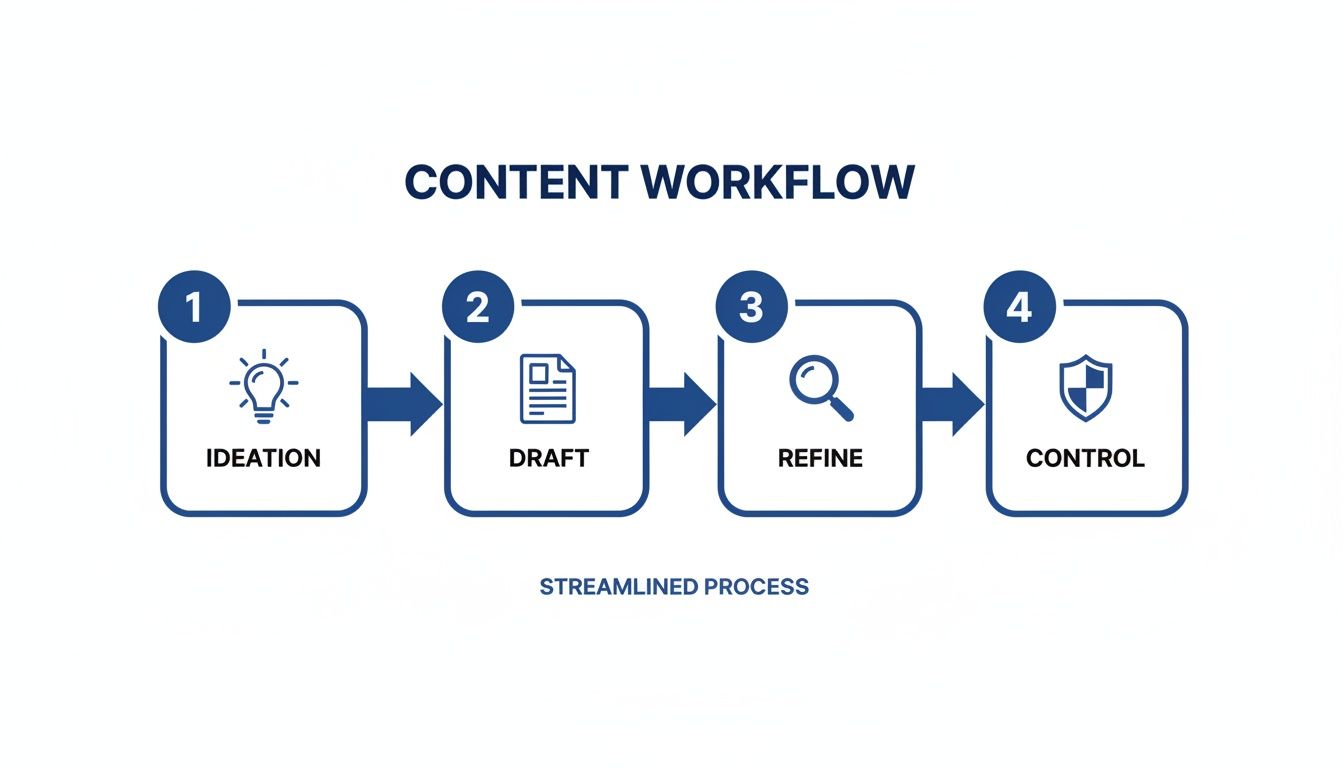
This balanced approach ensures you get the speed of AI without sacrificing the quality that only a human can provide.
For Business Professionals
Anyone in a leadership role knows the feeling of being buried in information. From lengthy market reports to never-ending email chains, the ability to quickly pull out what matters and communicate it clearly is vital for making smart decisions.
The Problem: A business analyst was tasked with summarizing a dense, 80-page market research report for an executive briefing. Manually reading, digesting, and extracting the key insights would have burned an entire day.
The Automated Solution: Instead, the analyst uploaded the report to an AI tool. In minutes, it generated a concise executive summary, identified the top five market trends, and even created a list of potential risks and opportunities.
The Results:
- Hours Back in the Day: The task was finished in under 30 minutes, not the eight hours it would have taken manually.
- Deeper Strategic Focus: The AI-generated summary gave the analyst a massive head start, allowing them to focus on interpreting the data and forming strategic recommendations.
- More Impactful Communication: The final presentation was sharper and more persuasive because it was built on a foundation of clear, distilled insights.
These examples all point to the same core idea: AI automation is brilliant at handling the repetitive, time-sucking parts of content creation. It frees up professionals to do what they do best—think strategically, get creative, and add their unique human value.
This isn’t just a niche trend; the market is exploding. The AI Content Creation Tool Market is expected to grow by an incredible USD 60.47 billion between 2025-2029, with textual content for things like SEO articles and emails already making up a dominant 45% share. You can explore more stats on the AI content market on technavio.com.
For more practical tips on how different roles can put these ideas into action, check out the Pulsaro blog.
Ensuring Quality and Ethical AI Use
Powerful tools demand responsible use, and automatic content creation is no different. It's tempting to hit "generate" and publish whatever comes out, but that's a fast track to mediocre results and a damaged reputation. The only sustainable strategy is a human-in-the-loop model.
Think of AI as an incredibly skilled but inexperienced assistant, not a replacement for your expertise. This partnership lets you keep the quality and trust you’ve worked so hard to build, while still getting a massive speed boost. Without your guidance, AI-generated content can easily become generic, factually wrong, or completely miss your brand’s personality. Your job is to steer the ship, refine the output, and add that final, irreplaceable layer of human insight.
The Human-in-the-Loop Gold Standard
An AI-generated draft is like a rough block of marble. It has potential, but it’s you—the sculptor—who carves out the fine details, smooths the edges, and turns it into a finished work of art. This back-and-forth process is what elevates automated content from passable to truly excellent.
These are the non-negotiable steps for solid quality control:
- Rigorous Fact-Checking: AI models can "hallucinate" and state incorrect information with absolute confidence. It’s on you to verify every statistic, claim, and quote against reliable sources before anything goes live.
- Plagiarism Prevention: While modern AI aims for originality, it can sometimes produce text that’s too close to its training data. Always run final drafts through a plagiarism checker to protect your brand’s integrity.
- Brand Voice Alignment: An AI doesn't know your inside jokes, your specific tone, or your unique perspective. A human editor is essential to inject that personality and make sure every piece sounds like it came from you.
The goal isn't just to make content; it's to make content that meets your standards. AI can get you 80% of the way there in a fraction of the time, but the final 20% of human polish is what creates real value and builds trust.
Navigating the Ethical Landscape
Beyond just making good content, using these tools responsibly means thinking through some important ethical questions. How you handle them directly affects your credibility and your relationship with your audience.
Three key ethical pillars should guide your work:
- Transparency with Your Audience: Don’t hide the fact that you’re using AI. A simple disclosure builds trust and shows respect for your readers. Getting caught trying to pass off machine-generated content as purely human work can lead to serious backlash.
- Data Privacy and Security: When you paste prompts into a cloud-based AI tool, your data is flying off to a third-party server. This is a huge privacy red flag, especially if you’re working with sensitive information. A local-first command center like Pulsaro helps solve this by keeping your work on your own machine.
- Preventing Misinformation: The power to create content at scale comes with a responsibility to make sure it’s accurate and helpful. Spreading false information, even by accident, erodes trust not only in your brand but in the digital world as a whole.
By making these practices part of your workflow, you can use automatic content creation both effectively and ethically. To get a better handle on data privacy and security, you can check out the legal policies and commitments that guide responsible AI platforms.
The Future of AI Is a Unified Workspace
The next big leap in automatic content creation isn't just about smarter AI models—it’s about how we work with them. Right now, most workflows are a chaotic mess of browser tabs, single-purpose apps, and a stack of different subscriptions. This scattered approach is clumsy and just plain inefficient. It kills your flow.
The future is a unified, desktop-native command center that weaves AI right into your existing work. Imagine having the world's best models for text, images, and video all in one place, with one consistent interface, right on your machine. This is where the real productivity gains are hiding.
Breaking Free from Fragmentation
A unified workspace like Pulsaro is built on this very idea. It’s designed to kill the constant context-switching that drains your focus and momentum. Instead of juggling a dozen different tools, you get one central hub where you can instantly grab the best model for any task.
For example, you could draft a blog post with GPT-4, have Claude summarize your research, and then get Perplexity to double-check your facts—all without leaving your project. This approach brings a few major advantages:
- One Subscription, All Models: Get access to every top-tier AI model without having to manage a bunch of different accounts and payments.
- Effortless Context Switching: Seamlessly hand off your work from one AI to another, playing to each model's unique strengths.
- A Standardized Interface: Work with the same prompt editor, history, and output format, no matter which AI you're using.
The real power of a unified command center is that it standardizes your workflow. It allows you to build a repeatable, efficient system for content creation, turning a collection of disjointed tools into a true production engine.
This kind of integrated environment creates a powerful, streamlined space for mastering automatic content creation. The focus shifts from managing tools to actually doing exceptional work. When you bring all your AI firepower into one place, you can move faster, think more clearly, and produce much better results.
Ready to see what this next-generation workflow feels like? A unified AI workspace makes the entire content creation lifecycle smoother and more effective, from start to finish.
Got Questions? Let's Clear a Few Things Up
As you start digging into automatic content creation, a few common questions always seem to pop up. Let's tackle them head-on so you can move forward with a clear, solid understanding of how to use this tech the right way.
Will Search Engines Penalize My AI Content?
This is the big one, isn't it? The short answer is no, as long as the content is genuinely good. Google has been crystal clear with its "helpful content" policy: what matters is whether you're creating something valuable for the reader, not how you made it.
The key here is quality, plain and simple. If you're just churning out spammy, low-value articles to game the system, you're going to get burned. But if you use AI as a partner to produce accurate, original, and insightful content that actually helps people, search engines will reward that effort. The focus is always, always on the final product's usefulness.
Google doesn’t care how helpful content is made; it only cares that it is helpful. This is why a "human-in-the-loop" approach is so essential—it’s your best bet for making sure AI-assisted content meets that high bar for quality and originality.
How Much Human Oversight Is Really Needed?
There’s no magic number here. The right amount of human supervision comes down to the task's complexity and what’s at stake if you get it wrong. Think of it as a sliding scale.
For low-risk tasks like brainstorming a few blog titles or knocking out a rough draft for a social media post, a quick once-over might be all you need. But when the content really matters, the need for a human expert skyrockets.
- High-Stakes Content: For things like technical articles, financial reports, or medical advice, rigorous fact-checking and a final review by a subject matter expert are non-negotiable. There's just no room for error.
- Creative Content: When you're crafting brand stories or an opinion piece, you need a human editor to inject personality, emotion, and an authentic point of view. That's the stuff an AI just can't fake.
The best practice is to always have a person involved to check for accuracy, get the tone right, and ensure the overall quality is up to snuff.
Is Automatic Content Creation Expensive?
Getting started with automatic content creation doesn't have to drain your bank account. While massive, enterprise-level systems can come with a pretty hefty price tag, the scene has become way more accessible for individuals and small teams.
The cost really depends on the tools you pick. Subscribing to a bunch of different specialized AI models one by one can get expensive—and complicated—fast. This is where unified platforms make a huge difference. Tools that bundle access to many top-tier AI models under a single, affordable subscription have dramatically lowered the barrier to entry. It's a smart approach that delivers serious value, letting you pick the best model for any job without juggling a dozen different bills.
Ready to bring all this together and master automatic content creation? Pulsaro unifies the world's best AI models into a single, native desktop app, giving you the power to create, refine, and scale your content effortlessly. Start your free trial at Pulsaro.ai.